Smart CRAH Control Modernization for Data-Centre Energy Optimization
How a legacy CRAH control system at a critical data centre was transformed into an intelligent Niagara 4 platform — delivering adaptive cooling, multi-unit coordination and ~32% energy savings.

Overview
This project transformed a legacy CRAH (Computer Room Air Handler) control system at a critical data centre into an intelligent, energy-efficient automation platform. By implementing advanced Niagara 4 control strategies, the cooling plant was upgraded to dynamically optimize cooling performance, airflow distribution and overall energy consumption — delivering improved reliability, full system visibility and substantial energy savings through smart, adaptive control logic.
The Challenge
Legacy control system inefficiencies
The incumbent CRAH controls ran on static logic with no demand awareness, no coordination across units and no real visibility into performance — wasting energy in a 24×7 critical-cooling environment.
- Continuous Operation
Cooling units ran constantly without demand-based control, leading to unnecessary energy consumption.
- Poor Airflow Optimization
Lack of intelligent airflow management caused overcooling and energy waste in specific zones.
- No Multi-Unit Coordination
Absence of coordinated operation across multiple CRAH units resulted in redundant cooling effort.
- Limited Adaptability
The system could not dynamically adjust to ambient conditions or real-time load variations.
- Minimal Visibility
Lack of detailed monitoring made performance insights difficult to obtain and operational optimization nearly impossible.
The Solution — Niagara-Based Smart Control Platform
TAS implemented a modern control system on the Niagara 4 framework, replacing static logic with adaptive, real-time intelligence. The platform integrates advanced edge controllers, distributed I/O, smart temperature/humidity/pressure sensors and open BACnet/Modbus integration with intelligent control algorithms — PID, cascade and “teamwork” logic across multiple CRAH units.
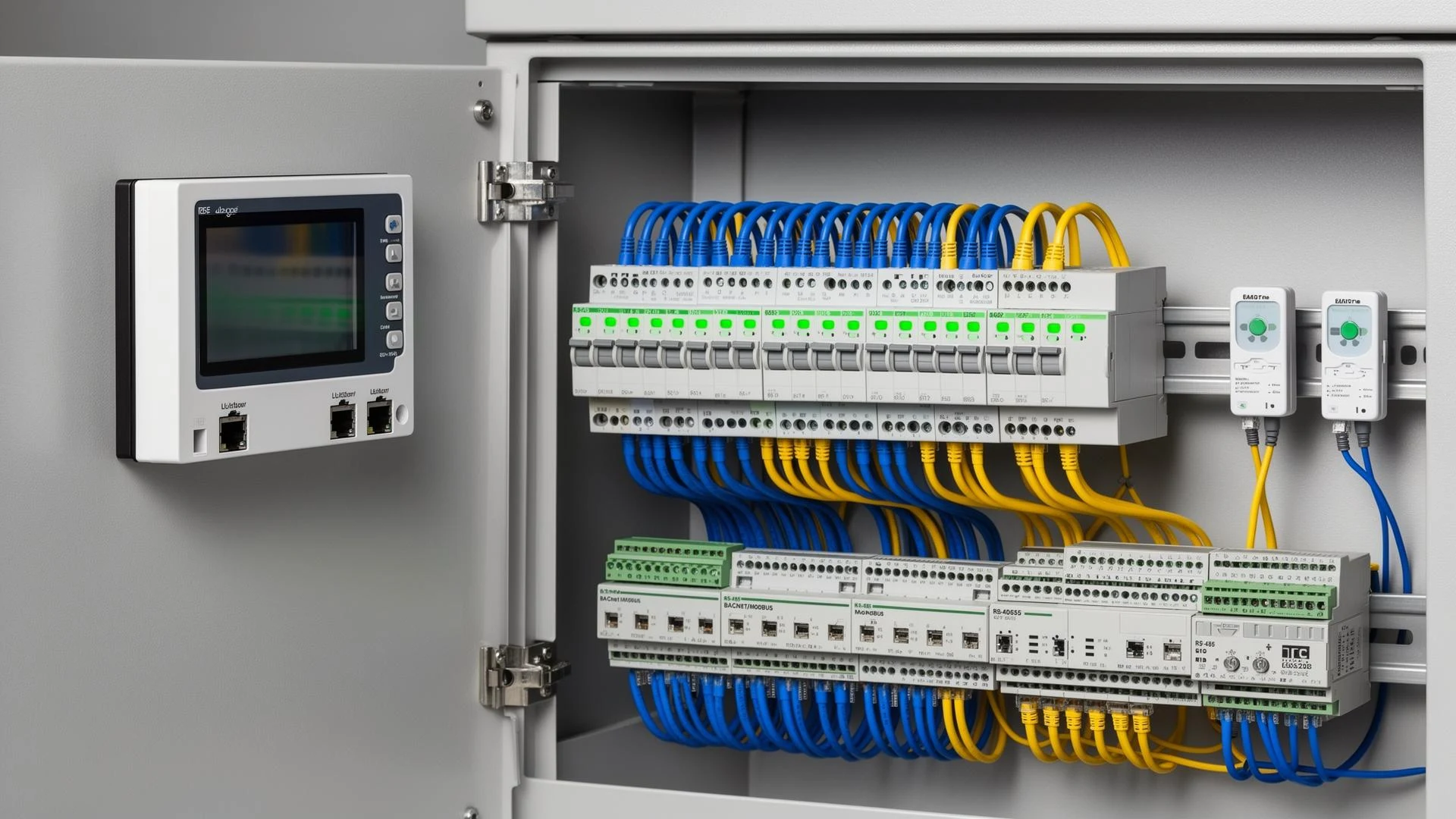
Implementation framework — Niagara 4 edge controller, distributed I/O modules, smart sensors and open-protocol integration that drive every CRAH in the room.
Solution Stack
Intelligent Control Functions
The platform continuously optimizes cooling by responding to environmental and load conditions in real time:
- Intelligent Cooling Capacity
Compressor and chilled-water valve modulation matches actual heat load — never more, never less.
- Smart Airflow Management
EC-fan / VFD modulation maintains target supply-air conditions and balances airflow across the room.
- Economizer Logic
Ambient conditions are leveraged automatically to offload mechanical cooling whenever possible.
- Multi-Unit Teamwork
CRAH units coordinate to share load, rotate runtime hours and eliminate redundant cooling effort.
Energy Performance Results
Side-by-side measurements comparing the legacy CRAH control with the new Niagara 4 smart control platform across the four key cooling metrics:
Energy Optimization Results — 50% lower cooling energy, 45% lower fan speed, 30% lower airflow loss and 20% lower overcool waste vs. the legacy control system. Combined overall energy reduction of approximately 32%.
Key Achievements — Real-Time Adaptive Performance & Reliability
- ✓Energy Efficiency — significant reduction in overall energy consumption through optimized cooling and intelligent fan modulation.
- ✓Stable Environmental Control — real-time adaptive control keeps temperature and humidity precisely within critical operating parameters.
- ✓Reduced Overcooling — intelligent coordination prevents overcooling and associated energy waste across multi-zone environments.
- ✓Fast System Response — advanced control algorithms enable rapid response to load variations without compromising stability.
- ✓Automated Operation — minimal manual intervention; the system runs autonomously with intelligent decision-making.
- ✓Proactive Fault Detection — smart alarms and predictive analytics catch issues before they impact critical operations.
- ✓Scalable Architecture — modular, flexible design enables easy expansion and integration with advanced analytics and future smart systems.
This project demonstrates how intelligent control systems transform traditional CRAH operations into energy-optimized, high-performance solutions. By combining adaptive logic, smart coordination and responsive control strategies, the platform delivers improved efficiency and reliability for mission-critical cooling environments.— Based on TAS India’s Smart CRAH Control Implementation
Outcome
By replacing static, single-unit control with a Niagara 4-based platform that coordinates every CRAH in the room, the data centre cut cooling energy in half, slowed its fans by nearly half and eliminated most of the overcooling waste — all while gaining the visibility, alarming and analytics needed to keep a critical-cooling environment running predictably 24×7.
Optimize your CRAH & data-centre cooling operations
From legacy control modernization to AI-driven predictive cooling — TAS delivers end-to-end Niagara 4 solutions for energy-efficient, mission-critical environments.