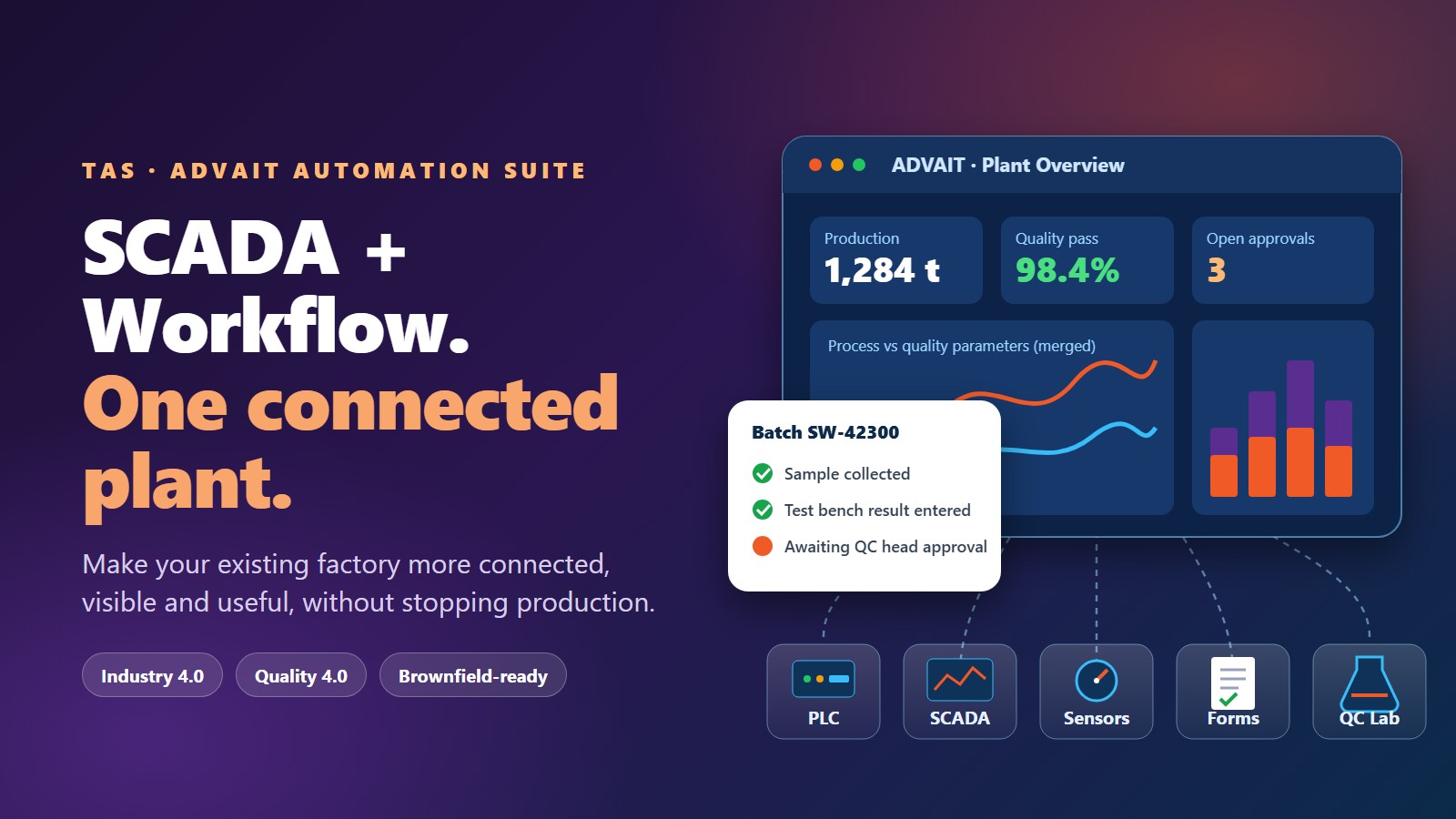
SCADA that also runs the work: connecting every machine, form and test in a brownfield factory
Most factories were built in phases, so they run many makes of PLCs, SCADA and legacy systems, plus a lot of paper. ADVAIT brings real-time plant data, manual entries and quality workflows onto one platform, without stopping production.
Today’s plants are heavily data-rich, yet the data stays disconnected, uncorrelated and hard to act on. Hours go into looking across systems and filling forms, and the QC laboratory adds days of delay. This article explains how the TAS ADVAIT suite combines a multi-vendor SCADA, IIoT data collection and workflow management in a single platform, and why digital transformation does not have to mean remove, replace, rebuild.
- One view of real-time process data, manual entries and workflows.
- Less paper: digital data-entry and workflow forms replace hand-filled sheets.
- Quality linked to production: process and quality parameters in one report.
- No shutdown: existing PLCs, SCADA and machines stay in place.
Data-rich, but disconnected
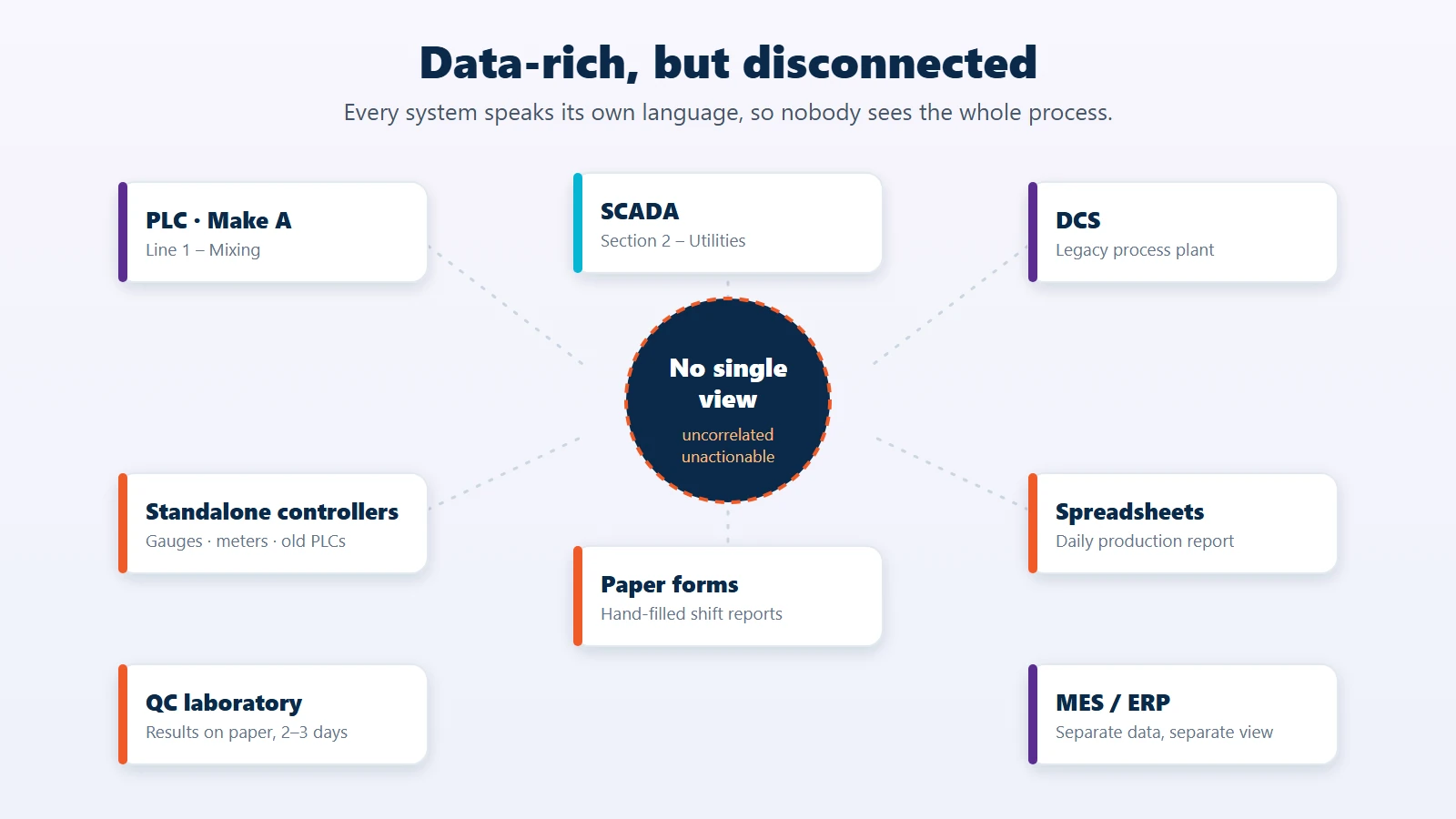
Most factories of today are built in a phased manner: backward or forward integration, capacity expansions, modernisation of one section at a time. Each phase brings its own automation, so the plant ends up with controllers, PLCs, SCADA systems, DCS and legacy systems from many makes, all automating material flows and processes.
Brownfield factories rarely speak just one language. The real challenge is getting machines, PLCs, SCADA, MES and enterprise systems to exchange consistent, meaningful data.
The result is a plant that is heavily data-rich but short on insight. A lot of hours are wasted looking at multiple systems to assemble one complete view of the production process.
They have become heavily data-rich, but remain disconnected, uncorrelated and unactionable.
The hidden cost of paper
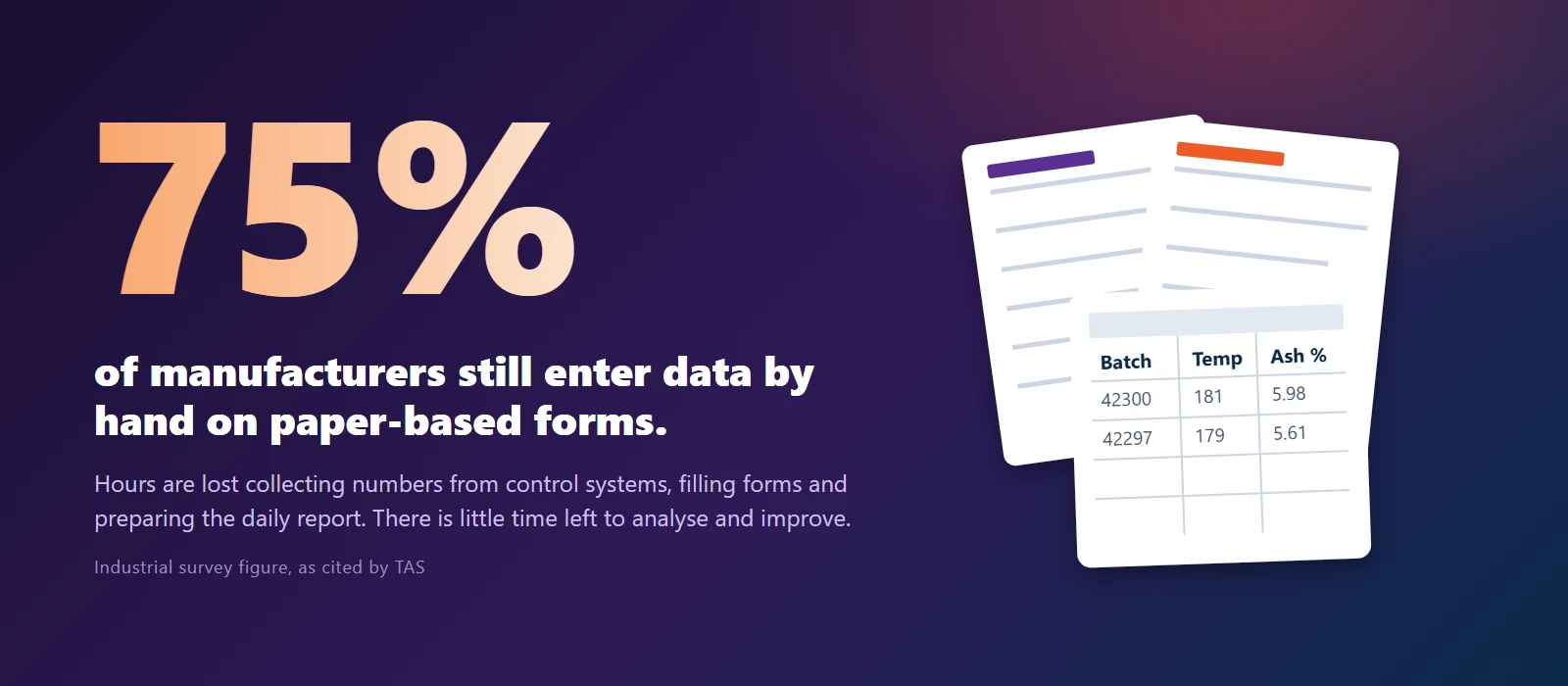
Even with several automation systems in place, plenty of work is left to manual data entry on paper forms or spreadsheets. Operators lose a good part of the day collecting numbers from control systems and preparing the daily production report.
The QC laboratory: where quality becomes a workflow
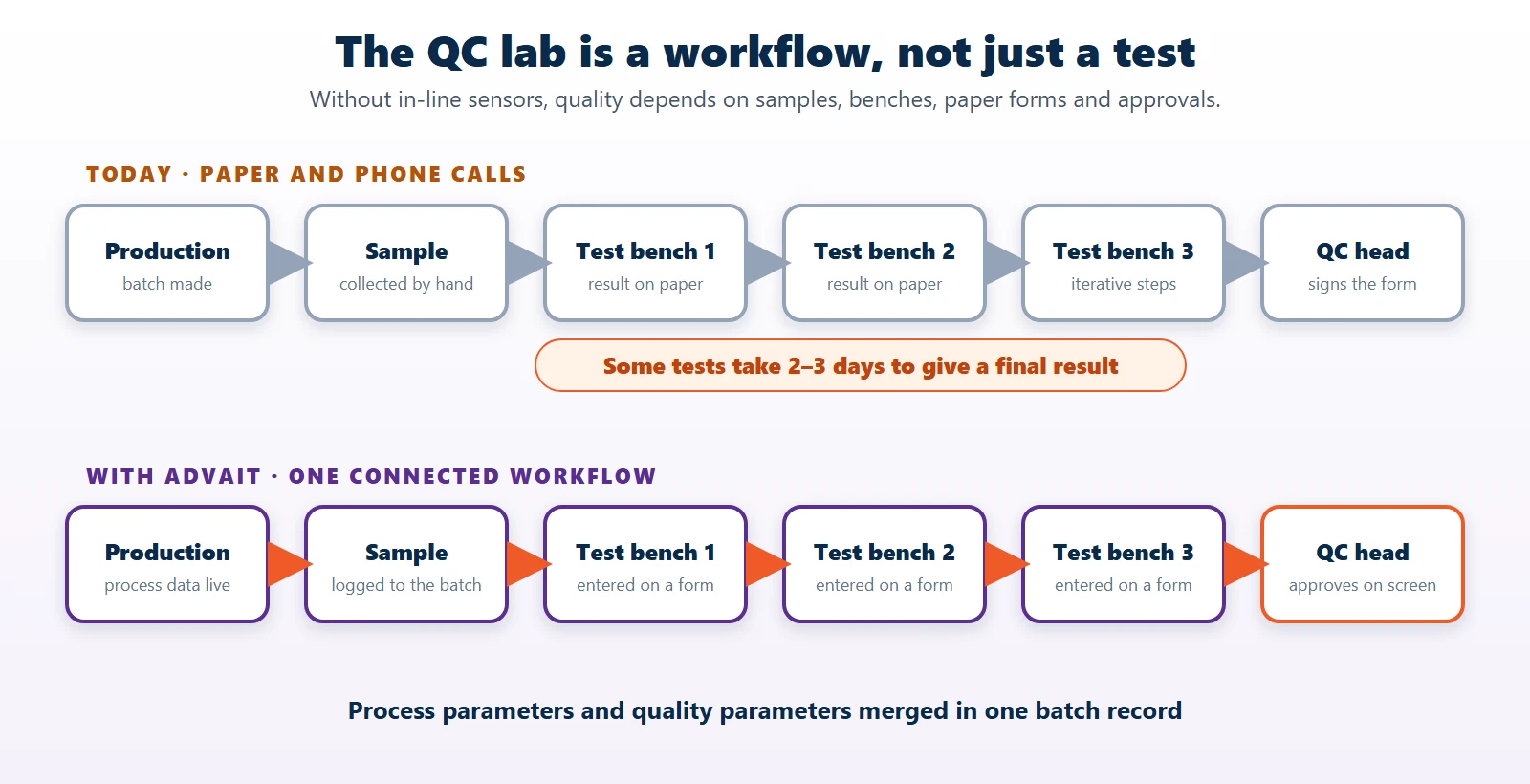
The last stage is the QC laboratory. In many manufacturing processes there are no in-line instruments for an instantaneous quality check. Quality depends on standalone test equipment and processes in the lab, and the results are again filled by hand on paper forms. Some tests are iterative and take two to three days to produce the final quality parameter.
So it is not only the manual form filling. It is a full workflow: sample collection, testing on one bench after another, and submission to the QC head for final approval. The next challenge for the quality and production heads is to link the production process parameters with the quality parameters.
ADVAIT: SCADA plus operational workflow management
Against this backdrop, the TAS automation software suite ADVAIT works as a conventional SCADA that interacts with the many makes of control systems on the plant floor. It also acts as an IIoT platform that collects data directly from IIoT-enabled sensors, and it adds user-friendly, customisable data-entry forms and workflow forms.
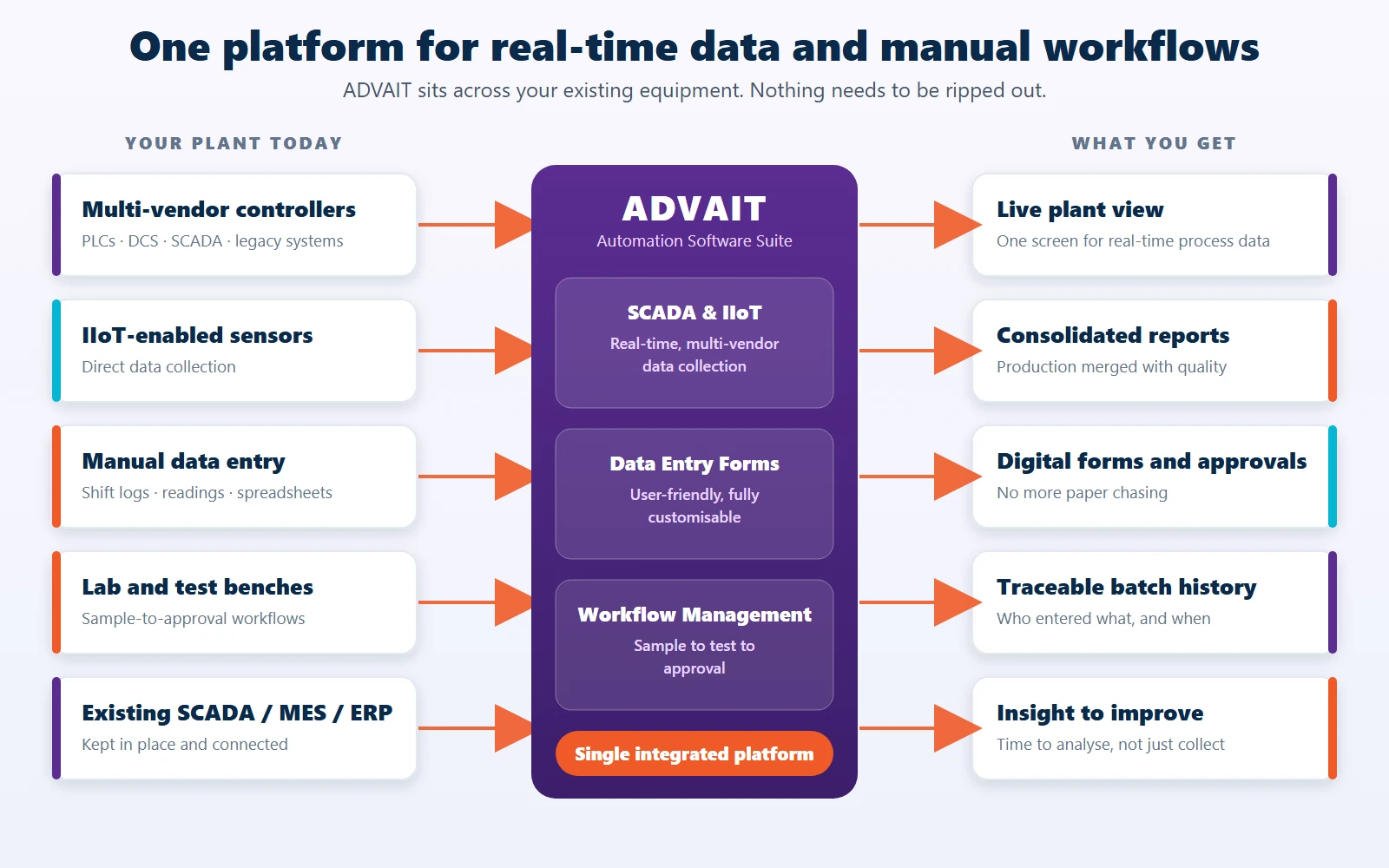
SCADA & IIoT
Real-time data collection from multi-vendor control systems, plus direct data from IIoT-enabled sensors.
Data-entry forms
User-friendly, customisable forms for readings, logs and records that are still entered by hand today.
Workflow forms
Sample collection to testing to final approval, handled on screen from one test bench to the next.
The result is a single integrated platform for real-time plant data, manually entered data and the operational workflows, whether they come from multiple real-time controllers, legacy systems, manual-entry forms or workflow forms. ADVAIT combines the real-time process data with the manual entries and workflow forms, and produces consolidated production reports with production parameters merged with the quality parameters.
Built for factories that cannot simply stop
ADVAIT is ideally suited to the digital transformation of older manufacturing units that cannot stop production and start again. They already have manual lines, old PLC-controlled machines, SCADA systems, gauges and meters, standalone controllers and manual test benches. Some equipment is relatively new, while other machines may have been running for 10, 15 or even 20 years and may still be reliable. Operators know how to use them, and maintenance teams understand how they behave and how to keep them running.
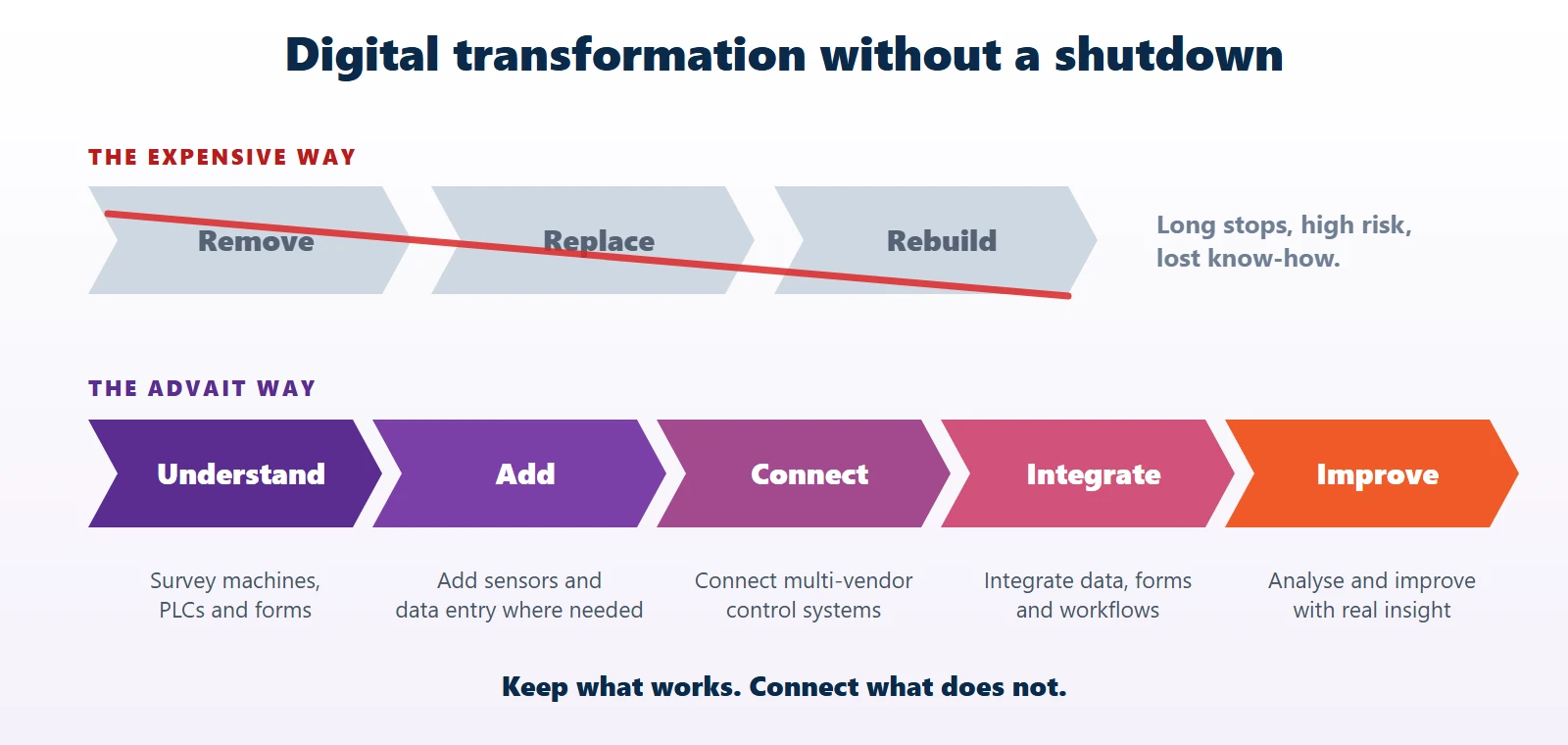
ADVAIT does not make your existing factory disappear. It makes the existing factory more connected, visible and useful. Becoming a digitally transformed smart factory with Industry 4.0, Industry 5.0 and Quality 4.0 does not mean you must remove, replace and rebuild the production floor. It can instead mean: understand, add, connect, integrate and improve.
What changes on the shop floor
A single view
Real-time process data, manual entries and workflows on one screen.
Less manual entry
Digital forms replace paper and spreadsheets for daily records.
Faster quality decisions
Test results and approvals flow through one workflow instead of paper.
Linked parameters
Production and quality parameters sit together in one consolidated report.
Familiar machines
Operators and maintenance teams keep the equipment they already know.
Time to improve
Less time collecting data, more time analysing it and acting.
How a project usually starts
- Walk the plantWe map your controllers, SCADA, machines, forms and test benches, and what each system is missing.
- Connect one areaWe connect a pilot section, add the forms and workflows that matter most, and prove the single view.
- Expand with confidenceWe extend to more lines, labs and sites, without disturbing what already works.
Ready to connect your plant without stopping it?
Share what you run today: PLCs, SCADA, MES, forms or test benches. We will show you what a connected view could look like.