
Wireless Condition Monitoring for Critical Rotating Equipment
Multi-parameter wireless sensors, edge gateways and intelligent analytics that detect bearing faults, imbalance and misalignment early — across pumps, fans, motors, compressors, gearboxes and centrifuges, including hazardous-area zones.
Reduced Unplanned Downtime
Lower Maintenance Cost
Hazardous-Area Ready · ATEX Zone 0–2

Unplanned failures cost more than maintenance ever will
Most rotating-equipment failures show measurable symptoms — vibration, temperature drift, acoustic signatures — long before breakdown. Catching them early is the single biggest lever for plant reliability.
Late detection
Bearing wear, misalignment and imbalance often go unseen until secondary damage forces an emergency shutdown.
Over-maintenance
Time-based maintenance replaces healthy parts and consumes labour and spares without adding reliability.
Blind spots
Remote, elevated or hazardous-area assets are inspected infrequently — manual rounds miss intermittent faults.
Wiring cost
Conventional online monitoring requires expensive cabling, junction boxes and shutdowns to install.
Three layers, one connected reliability platform
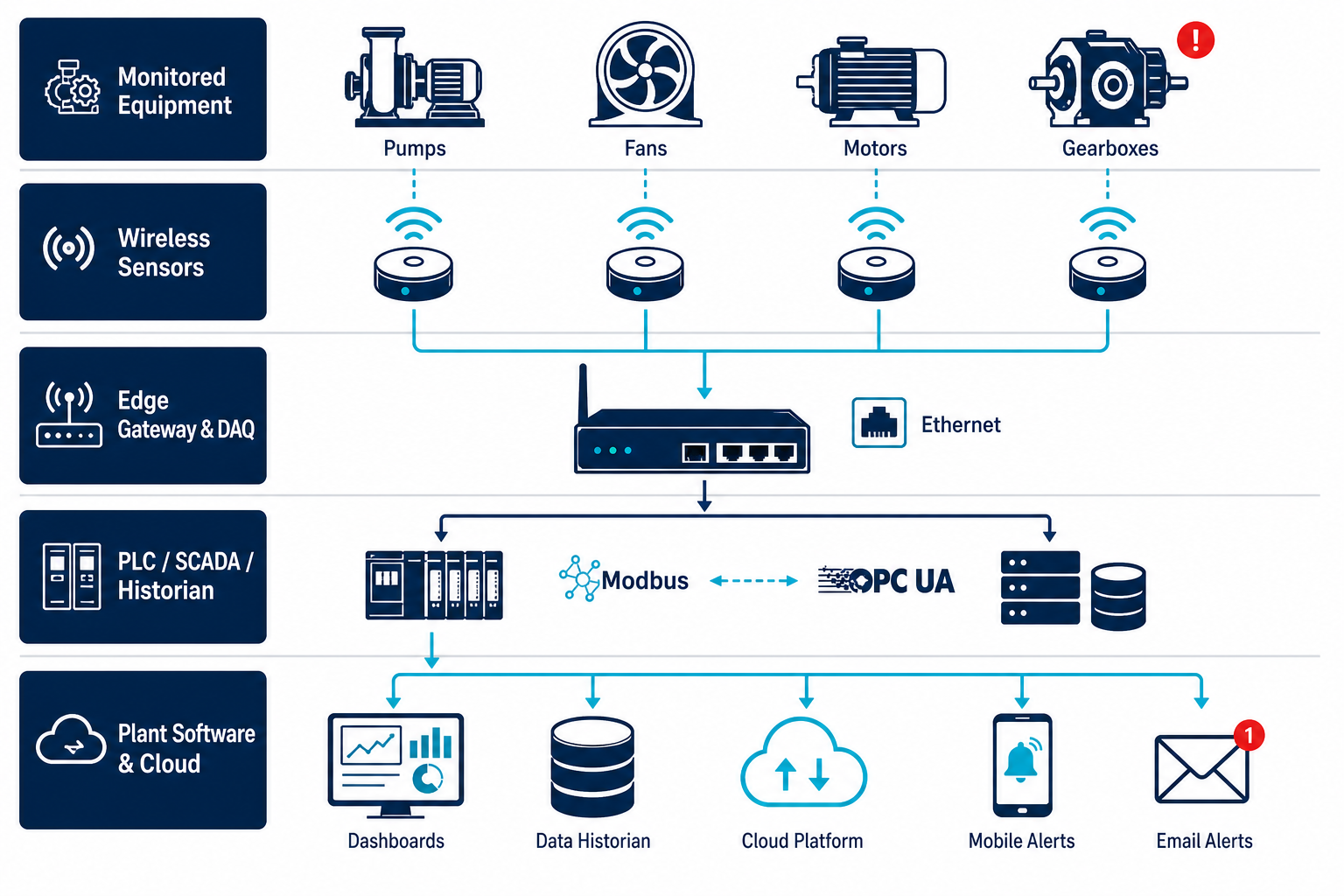
A retrofit-friendly stack that combines multi-parameter wireless sensors, plant-grade gateways and a health-monitoring application — fully integrable with your existing PLC, SCADA, Historian and CMMS.
Wireless Multi-parameter Sensors
Battery-powered, IP67, hazardous-area certified sensors capture vibration, velocity, temperature, acoustic and process variables on every critical asset.
Edge Gateways & DAQ
TASM2M gateways aggregate sensor data, run alarm-triggered acquisition, and bridge wireless signals to your plant network and control systems.
Health Analytics Software
Asset-health dashboards, dynamic-threshold alarming, fault-type tagging and long-time waveform analytics turn raw signals into maintenance decisions.
Wireless Multi-parameter Vibration Sensors
Compact, battery-powered sensors built for harsh and hazardous machinery environments. One device, eight measured parameters, no cabling.
Built for plant reality
- Wireless transmission: Bluetooth ~50 m or LoRa up to 2 km
- Integrated antenna, low power consumption, multi-year battery life
- On-board storage and harmonics processing
- Magnetic / stud / adhesive mounting on motor & equipment housings
Certifications
Ready for hazardous and harsh environment machinery:
Ex ia IIC T4
Zone 0–2
IP67
CE
FCC
TASM2M Wireless Gateway
A rugged plant-grade gateway that aggregates sensor data, time-stamps it accurately and bridges wireless networks into your existing control and IT systems.
Specifications
- Ingress protection: IP66 housing for outdoor / wash-down installation
- Wireless range: ~300 m line of sight
- Channels: Supports up to 45 sensor channels per gateway
- Uplinks: Ethernet, fibre optic, Wi-Fi, Bluetooth, optional 4G
- Power: Low consumption, plant DC / AC supply
Integration
- OT protocols: Modbus TCP/RTU, OPC-UA
- IIoT protocols: MQTT, REST
- Operating-condition input from PLC/DCS for state-aware alarming
- Connects to existing SCADA, Historian, CMMS and ERP without rip-and-replace
From sensor to dashboard, end-to-end
A layered architecture that scales from a handful of critical assets to plant-wide deployments, while integrating cleanly into your existing automation stack.
Health Monitoring Software
Statistics, alarm management and machinery health views designed for field engineers, reliability teams and plant managers.
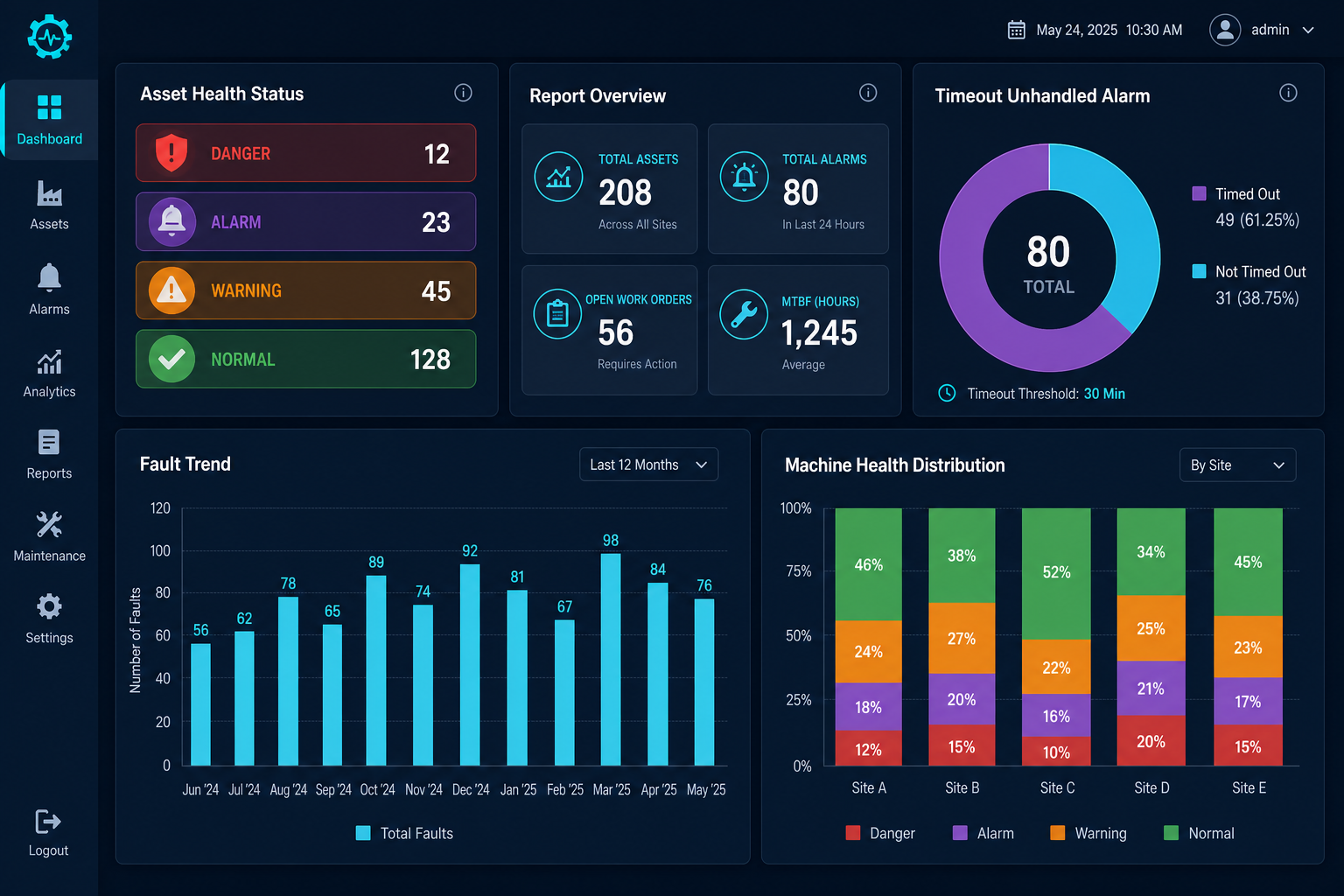
Asset Health Status
Live count of assets in Danger / Alarm / Warning / Normal states across the plant.
Fault Trend
Monthly and yearly fault trends to track reliability program effectiveness.
Machine Health Distribution
Health breakdown by department, area or asset class for quick triage.
Alarm Board
Unhandled and timed-out alarms surfaced for the engineer on shift.
Reports & Diagnostics
Medical-style asset reports, fault-case statistics and root-cause analysis.
Mobile & Email Alerts
SMS and email notifications routed to the right responder, with escalation.
Beyond static thresholds
Real machines run under variable load. Static high/low limits create nuisance alarms — or miss real ones. Our analytics adapt to operating context.
Dynamic Thresholds
Alarm bands learn from healthy operating envelopes per RPM, load and process state.
Alarm-Triggered DAQ
On alarm, sensors switch to high-resolution sampling so the diagnostic record is complete.
Priority Channel
Alarm packets are transmitted first over a green channel — even on constrained links.
Long-Time Waveform
Continuous waveform records correlate vibration with process load changes for clean root-cause analysis.
Fault Tagging
Bearing inner/outer race, imbalance, misalignment, looseness, gear-mesh and cavitation patterns are tagged automatically.
Operator Confirmation
Engineers can validate or reclassify diagnoses; the system learns from confirmed cases.
Coverage across rotating-equipment classes
Pumps
Centrifugal, positive displacement, vertical turbine — bearings, cavitation, seal health.
Fans & Blowers
ID/FD fans, exhaust fans, cooling-tower fans — imbalance, blade fouling, bearing wear.
Motors
LT/HT induction motors — bearing condition, shaft alignment, thermal trending.
Compressors
Reciprocating and screw compressors — valve, bearing and lubrication monitoring.
Gearboxes
Gear-mesh defects, tooth wear, lubrication and bearing condition trending.
Conveyors & Centrifuges
Drive trains, idlers and high-speed centrifuges with fault and unbalance detection.
The failure modes we catch early
Bearing Faults
Inner / outer race, rolling element and cage defects via envelope and high-frequency analysis.
Imbalance
1× RPM dominance from mass imbalance, fouling or build-up on rotors.
Misalignment
Coupling and shaft misalignment detected through 2× RPM and axial vibration patterns.
Looseness
Mechanical and structural looseness from harmonic vibration signatures.
Cavitation
Broadband acoustic and high-frequency vibration on pumps under poor suction.
Gear Mesh
Gear-mesh frequency anomalies and sidebands on gearbox-driven assets.
Lubrication Issues
Bearing temperature drift and high-frequency stress correlated with lubrication state.
Process-induced Vibration
Long-time waveform separates load-related vibration from real machinery faults.
From signal to action in one closed loop
Sense
Wireless sensors capture vibration, temperature and acoustic data on every monitored asset.
Aggregate
Edge gateways collect data, time-stamp it and forward to plant software.
Detect
Dynamic thresholds and pattern analytics flag deviations from healthy operating bands.
Diagnose
Fault patterns are tagged: bearing, imbalance, misalignment, looseness, cavitation.
Notify
The right responder is alerted via dashboard, SMS and email, with severity and trend context.
Act
A condition-based work order is raised in the CMMS and closed against the verified diagnosis.
Field-validated outcomes
A selection of how the same building blocks have been deployed across industries. Specific customer references available on request.
Exhaust Fan Monitoring
IIoT vibration monitoring on cement-plant exhaust fans (motor + fan).
- 5 measurement points: motor & fan bearings + vibration RMS
- Detected: bearing damage, imbalance, misalignment
- Reduced unplanned exhaust-fan trips and inspection rounds
Centrifuge Reliability
Online wireless condition monitoring on sugar-plant centrifuges.
- Continuous vibration recording with fault classification
- SMS & email alerts to plant engineers and supervisors
- Corrective recommendations based on fault signatures
Bearing Failure Caught Early
Acceleration alarm on the 3H measurement point flagged a deteriorating pump bearing.
- Inner-race bearing damage confirmed by waveform analysis
- Planned shutdown executed; catastrophic failure avoided
- Repair scope limited to bearing replacement, not the full pump
Reliability gains you can measure
Typical ranges seen across deployments — actuals depend on asset criticality, current maintenance maturity and integration depth.
Deploy the way your plant runs
Plant-Hosted
All software on plant servers — fully air-gapped from the internet where required.
Hybrid
Operational data stays on-premise; reporting and remote access via secure tunnel.
Cloud
Multi-site hosted deployment with role-based remote access from web and mobile.
Hazardous Area
ATEX Zone 0–2 sensor variants for refineries, oil & gas and chemical plants.
An automation partner, not just a sensor vendor
- Domain expertise across cement, oil & gas, sugar, chemicals, power and process industries
- Retrofit-friendly wireless deployment — minimal cabling, minimal downtime
- Hazardous-area certified hardware (ATEX, Ex ia IIC T4, IP67)
- Native integration with existing SCADA, Historian, CMMS and ERP
- End-to-end ownership — sensors, gateways, software, commissioning, training
- Engineering-led diagnostics review with your reliability team
- Vendor-neutral — works alongside your installed control systems
- Local support and long-term spares & firmware lifecycle
Ready to monitor your critical equipment?
Talk to our reliability engineers about a pilot on your most critical pumps, fans, motors or compressors.